
[Islamabad] In a tit-for-tat response to escalating tensions, Pakistan banned Indian-flagged warships from its ports on Saturday, following a fatal incident in Indian-administered Kashmir. According to a directive issued later that day by the Ministry of Maritime Affairs’ Ports and Shipping Wing, “In order to safeguard Pakistan’s maritime sovereignty, economic interests, and national security, Indian-flagged vessels will not be permitted to visit any Pakistani port; Pakistani-flagged vessels shall not visit any Indian port.” India’s broad moves on Saturday, including blocking trade, mail service, and port access, prohibiting imports, and restricting port visits, spurred Pakistan to reciprocate.
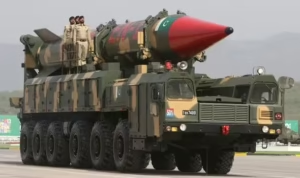
Following the Pahalgam incident, India immediately blamed Pakistan and took a series of unilateral actions, including suspending the Indus Waters Treaty, closing the Atari border, rejecting visas for Pakistani people, and downgrading diplomatic relations. In retaliation, Pakistan restricted its airspace to Indian airlines, closed the Wagah border crossing, suspended bilateral trade, canceled visas for Indian citizens, and threatened to withdraw from the Shimla Agreement. Both countries placed their armed forces on high alert in response to the increasing tensions. The situation remains tense, with both sides closely monitoring each other’s military moves, stoking concerns about future confrontation. Pakistan’s military stated Saturday that it successfully tested a surface-to-surface Abdali ballistic missile with a range of 450 kilometers (280 miles).
Following the Pahalgam incident, India immediately blamed Pakistan and took a series of unilateral actions, including suspending the Indus Waters Treaty, closing the Atari border, rejecting visas for Pakistani people, and downgrading diplomatic relations. In retaliation, Pakistan restricted its airspace to Indian airlines, closed the Wagah border crossing, suspended bilateral trade, canceled visas for Indian citizens, and threatened to withdraw from the Shimla Agreement. Both countries placed their armed forces on high alert in response to the increasing tensions. The situation remains tense, with both sides closely monitoring each other’s military moves, stoking concerns about future confrontation. Pakistan’s military stated Saturday that it successfully tested a surface-to-surface Abdali ballistic missile with a range of 450 kilometers (280 miles).
According to the Pakistan Armed Forces’ media wing, Inter-Services Public Relations, the launch was carried out to assess operational readiness and certify the missile’s advanced navigation system and maneuverability. The test, conducted by Pakistan Army strategic command troops, coincided with Islamabad’s warnings of a possible Indian assault, claiming “credible intelligence.” The Indian media outlet The Hindu stated that India saw the missile launch as a “blatant” act of “provocation.” Meanwhile, Indian Prime Minister Narendra Modi offered the military “complete operational freedom”. Pakistan, in turn, claimed to have “credible evidence” of an impending Indian strike and promised to respond firmly. Pakistan mourned the deaths in Kashmir, denounced all forms of terrorism, and demanded an unbiased international probe .India has not responded to the offer.
Pakistan has issued a strong warning following India’s suspension of the Indus Waters Treaty, which is a foundation of bilateral cooperation. Any disruption to Pakistan’s water supply is viewed as a national security danger. Prime Minister Shehbaz Sharif cautioned that such a move could be interpreted as an act of war.
Kashmir is the central point of contention between India and Pakistan, sparking three wars and several skirmishes since 1947. A short confrontation in Kargil in 1999 underscored the dangers of nuclear escalation, emphasizing the critical need for diplomacy and patience. Following the Pahalgam attack, Pakistan undertook a diplomatic drive to reduce tensions. Prime Minister Shehbaz Sharif sought mediation from Gulf allies, notably Qatar, and Deputy Prime Minister Ishaq Dar spoke with leaders from Egypt, Turkey, Saudi Arabia, and China. Islamabad also sought out to the United States, with Secretary of State Marco Rubio advising caution.


0 Comments