
The streets of Tbilisi resonated with dread on Sunday, as preliminary results showed the ruling Georgian Dream party taking a significant lead in Saturday’s election. With 99% of precincts reporting, Georgian Dream has 54.2% of the vote, solidifying its hold on a nation divided over its political future. The majority of opposition party leaders claim that the poll, which was billed as a referendum on Georgia’s course towards greater Western alignment or closer ties with Russia, was manipulated. Based on the preliminary findings, the opposition struggled to launch a significant challenge. Initial tallies show the Coalition for Changes at 10.8%, Unity-National Movement at 10%, Strong Georgia at 8.7%, and Giorgi Gakharia’s For Georgia party at 7.7%.
As exit polls were revealed, both the ruling party and the opposition declared victory, but the official results rapidly favoured Georgian Dream, which won its fourth term with more votes than in the previous election. “Such cases are rare worldwide, where the same party achieves such success under such challenging circumstances,” Bidzina Ivanishvili stated shortly after the first exit polls were revealed. The oligarch is regarded as Georgian Dream’s genuine leader.
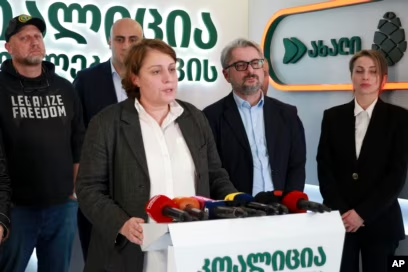
Soon after, Hungary’s Victor Orban hailed the Georgian Dream, while Margarita Simonian, editor-in-chief of Russian state-controlled network RT, commented on Telegram, “Georgians won, well done.” “This is election theft, a constitutional coup, and Georgian Dream will answer for it according to Georgian law,” said Nika Gvaramia, a Coalition for Changes leader. He said his coalition had discovered a “technological scheme” to alter election results. “We promised to protect your votes, and I apologise for not identifying this complex scheme earlier,” she stated. Elene Khoshtaria, another Coalition for Changes member and Droa party head, agreed with Gvaramia. “We are steadfast and resolute in our belief that this election was stolen, and we will not accept it.
The Unity-National Movement likewise believes that the elections were stolen. “Oligarch Ivanishvili stole Georgia’s win and, with it, the European future. “On behalf of the Unity-National Movement, we declare that we do not accept the election results,” Tina Bokuchava, party head, stated. Some independent observers also criticised the stated result. “Based on our research of the pre-election climate, widespread manipulation on election day, and extraordinary voter pressure, we feel that the CEC’s preliminary results do not accurately reflect the desire of Georgian residents. Londa Toloraia of the NGO coalition stated, “We will continue to demand the annulment of these results.”
Many commentators in the country believe that the ruling party’s success stems from fraud. Other commentators claim that Georgian Dream’s triumph was due not only to its strengths, but also to the opposition’s flaws. Because of internal divisions, a lack of defined programmes, and fluctuating political allegiances, opposition parties were unable to present a compelling alternative to the incumbent party. A 20-year-old first-time voter, who requested anonymity, stated, “I voted for a change… by a process of elimination.” Many people expressed this sentiment. “The opposition appears bankrupt, having relied on the hope that a) the Georgian Dream would collapse on its own, or b) the West would eventually topple Ivanishvili’s regime.” As a result, they failed to run a serious campaign.
Adding to this is the West’s lack of moral clarity, which is characterised by reluctance, ambiguity, and a ‘leading from behind’ attitude – granting EU candidate status one moment, suspending it the next; implementing penalties, but mainly on minor players,” he stated. Prior to the election, the United States and the European Union expressed alarm, citing a perceived departure from democratic principles and stronger relations to Russia. “The image is extremely clear now—despite pressure, intimidation, violence, and vote-buying, they lost the capital and Rustavi, as well as by a disastrous landslide abroad. However, in places with less monitoring and where people are more vulnerable and reliant on the state, Kadyrov-style numbers of 80-90% were achieved. The world community cannot agree that this is fair and Square
Analysts and opposition politicians have warned that Ivanishvili is leading the country towards Russia by increasing control over the media and independent institutions. Earlier this year, the government enacted a contentious “foreign agent” statute based on Russian laws. It focuses on NGOs and media outlets that receive foreign financing, primarily from the West. The law sparked significant protests around the country, prompting a severe response from the government.
Like their leaders, many opposition voters distrust Georgian Dream’s leadership. “No one around me voted for them.” “How did they get a million votes?” said Davit, a man in his thirties. Another expressed dissatisfaction with Georgians, saying, “The government you elect is the government you deserve,” while a third added, “They’ve sold out the country for a 300 GEL (around $120) salary.” Georgian Dream’s key supporters include “budget voters,” public sector employees, and social assistance recipients, particularly in rural areas where job opportunities are scarce. The party relies on these voters, many of whom are concerned about losing their jobs or benefits if the party fails to win. “The election that was held was neither fair nor free,” stated the Free University’sGeorgian Dream has formed strong ties with a diverse spectrum of political players and groups over the years, including pro-Russian socially conservative groups and street hooligans, as well as the widely popular Georgian Orthodox Church. “Last week, my priest officially asked us from the pulpit to vote for Georgian Dream,” said Rusudan, a middle-aged voter. “He even said anyone voting for the opposition would lose the right to communion.” This message, repeated in churches around the country, has helped Georgian Dream gain support among religious and traditionalist voters over the years. The ruling party portrayed the election as a choice between war and peace, accusing domestic and international critics of belonging to a “global war party,” a term stolen from Kremlin propaganda. For a country.
Meanwhile, the opposition framed the election as a vote on falling under Russian influence. “Amid mounting Russian aggressiveness and a timid West unable to defend its values, anti-Western and anti-liberal forces are becoming more powerful in our region. These groups expertly exploit the West’s failure to preserve its principles, using Russia’s unpunished aggression against neighbouring countries as an example,” Ramishvili added. Georgian Dream is currently celebrating its apparent victory. However, many Georgians, particularly young urbanites, are getting disillusioned. As the results are announced, Georgia confronts deep divisions and an uncertain route ahead.


0 Comments